Showing posts with label japan. Show all posts

Thursday, 18 July 2019

I've written a book about Matsue

It’s been a while, hasn’t it? Apologies for that, but I can’t see myself getting back to regular blogging any time soon. Nevertheless, I still write and, more pertinently, I still write about Japan. After a recent trip to Japan I found myself a bit perplexed that there was no book about Matsue on the market (apart from Glimpses of an Unfamiliar Japan by Lafcadio Hearn, but that’s over a hundred years old). So I sat down and wrote one!

[EDIT: Just to add that I've written a guest post for Tourist In Japan about Matsue.]

It’s an introduction to the city, but very much from my experiences there. I did a little research to add a little background, but it is by no means a history of Matsue. I thought I’d mention it here on the off chance it’d interest you. It’s on Amazon only (self-published Kindle, you see).

EDIT: 14/12/2021. It's been a while and during this whole lockdown thing I've been rewriting my book. It's now got a different name: Matsue, Japan: Seven walks through seventeen centuries, because it's a little more accurate and also I figured I needed the word "Japan" in the title somewhere. So it's now almost twice as long and three times as good. Here's a link to it in the UK store.


Monday, 2 April 2018

Matsue for the third time

I once read a tourist book that recommended three days for a thorough exploration of Matsue, so considering that by the end of this holiday I would have been here as a tourist for about two weeks, you'd be forgiven for wondering if there was anything left for me to do.

There were a few things, mostly personal things that you don't find in tourist guides. Things I'd noticed in passing at the time and had slowly grown into obsessions since then.

Two of these things related to small forests. One was in Yasugi: I'd stopped off here in 2012 on my way to the Adachi Art Museum and taken a photo of a tree-covered hill with a red torii visible through a break in the trees.

The photo I took in 2012

The other was actually in Matsue itself. A tree-topped hill that seemed to rise and fall out of the suburbs for no reason.

View of the hill, as seen from near the Shimane Art Museum

I had noticed it the first time I came to Matsue, but never got round to exploring it. This time, I was determined to solve the mystery of both of these places.

There was also the small issue of a Lantern Festival I wanted to see, as well as revisiting old haunts.

On my way to the hill in Yasugi, called Togamiyama Nagisa Park, I walked past this crazy beautiful house build in the style of a Japanese castle. But slightly ramshackle, and not quite right. But it was so amazing to look at, I can totally believe this was intentional.


And the park itself was quite an adventure. Especially if you hate spiders.

Plenty of these

The spiders would build their webs across the path, giving any walker the choice of ducking under them or brushing them aside. And, frankly, brushing them aside wasn't really an option. These weren't dry, wispy cobwebs I was used to, but they were strong, sticky and broke with an almost audible snap. I decided to avoid them as much as possible.

Found this on the hill


Not sure what this used to be

Success! A five year old mystery solved!

The hill in Matsue can be access through the back of the temple Enjou-ji. It's pretty small, but still full of spiders and mosquitoes and I got bitten quite a lot during this walk. I think it was worth it, though.

I saw a lot of these stone lanterns with these strips of paper attached to them

Not sure what they are.

Found an old cemetery

The Lantern Festival, held around the grounds of Matsue Castle, was very pretty.


Not only that, I also enjoyed revisiting places to see if they'd changed.

They still haven't cleaned this mirror


I also went to Suito restaurant, where I'd been on my previous two trips here and I was very pleased when they recognised me. I also went to Dorobou Bar, where I went on my first time in Matsue. The bartender who'd served me was still there. In fact, she was now the manager. She didn't remember me, though people tried. I don't know who “James” was, but he must have made an impression, since two people asked me if I was him.

Grapefruit! Karaoke!

Someone brought in grapefruit and shared it round, which was nice of him. And I even sung a song on the karaoke, after a lot of drunken persuasion from a salaryman. I chose Kaze Wo Atsumete, since it's the Japanese song I know most words to. People either ignored me or were politely appreciative.

Actually, I had arranged this trip with the idea that this'd be my last journey to Matsue, but I had so much fun (and I still haven't gone to Yaegaki Shrine) that I guess I'll go at least once more.

Saturday, 24 March 2018

Tokyo for the second time

In October last year, I visted Japan agin. This time I decided to spend half of my vacation in Tokyo. I’d been once before, but only for a few days which really isn’t long enough. This time I stayed for a week, which still isn’t long enough but is better than before.

I arrived during a heavy downpour and took a while to find my hotel. I felt a bit self-conscious as I booked in at reception, soaking wet, and left a puddle where I had been standing. Not only that but the rain got into my luggage and soaked my neatly folded clothes in new and interesting ways. In this photo you can see it looks like I’ve been wearing a wet bra under my nice dry jumper.


I went to Kamakura on one of the rare days of good weather to look at the temples and the Daibutsu. The place was full of tourists, but luckily most things you want to photo are quite high up, so they don’t get in the way.


Being the contrary type, I preferred the temples that were a furthest from the centre. My feet didn’t appreciate the walk there, but the Zuisenji Temple was a welcome relief from the crowds. It’s also quite unlike the other temples in that the grounds are not sparse and neat, but featured dense gardens making every pathway seem a bit secret and exciting.


I based myself in Nippori, north of Ueno Park, which is just next to Yanaka. This is one of the quieter pockets of Tokyo which has escaped too much redevelopment. I took a walk recommended in my 1980 tour book to see how accurate it still was. And for most of the time, apart from a couple of shops which had closed, it was still pretty much spot on. It lead me from one temple to another, ending up at the Nezu Shrine with its small but pretty pathways of toriis.


I also found this cafe, which I absolutely loved. Not just because I really needed a sit down, but also for the decor and the food which were both very nice.


Talking of Yanaka, I visited a very nice (and brand new) Sake bar Chin-nen, and I spent a nice evening trying different types of sake and chatting to the manager, who spoke some English (and a little French, too). I asked him what the name meant and he admitted it didn't really mean anything.


A few years ago, on my other blog, I wrote about my attempts at locating a Japanese street I found on an old piece of film footage.

Ever since then, I've always wanted to go back and see if anything at all remains from that day to this. Looking on Google Street View suggested that there wasn't but I thought that, since I was in the neighbourhood, I'd go and have a look for myself.


And I was very pleased to find something: The air vents for the underground system. I'm sure that the actual grills have been replaced, but this is an example of something with the same function in the same place after seventy years which, in a city that reinvented itself as radically as Tokyo, seemed pretty special.


Finally, just because it's one of those things I thought I should do at least once, I went for a night out in Roppongi.


It was very expensive, as I knew it would be, costing about £60 which is an awful lot for a few drinks at a bar and some live music. Good job I didn't order food. But I think I chose well, going to see a Beatles tribute act at the club Abbey Road.


The staff were very friendly and several came to chat with me, although I was a little embarrassed to admit to each one that I'd never actually gone to Liverpool despite my love of The Beatles. Plus, my last drink was free which was a nice gesture.

So those are the highlights of my trip to Tokyo. I hope to write more about my return to Matsue soon.

Super Mario gives no shits about the rain.

Saturday, 17 March 2018

Japanese soundscapes

When you come back from travelling, you will probably have some photos and films, some souvenirs and some local foods to help you relive those memories.

But sounds are often overlooked. Possibly because they're not as easy to capture as a visual image and possibly because, when you're constantly seeing and tasting new things, it doesn't occur to you to stop and listen.

The website https://aporee.org/maps/ goes some of the way to solve that. It hosts a large number of soundscapes that have been uploaded by people, which are then pinned to a map of the world so you can browse by location.

There are fascinating clips from everywhere and it's easy to lose hours just going from one place to the next, but I'll be concentrating on those from Japan.

There's quite a large selection, taking in all the usual images people have about Japan, from Akihabara and a Sega arcade to temples. Quite a lot of temples, actually. While I was interested to hear unique and location specific sounds, I found that the more everyday sounds, like the chimes of a train crossing, are the ones that make me feel nostalgic. I mean, the sound of a shamisen being played on a beach in Okinawa Prefecture is very nice, but I don't get the same personal connection that I do with the sounds of a city street.

Nevertheless, this website gives you a chance to explore new things as well as the familiar. There's an eight minute recording from a temple in Hamamatsu and, oddly, a lengthy excerpt of John Cage’s “Lecture on Nothing” read aloud (in English) in Kyoto.

With the whole world to listen to there is, quite literally, something for everyone. I found that there’s a sound recording made at the end of the road where I live! An impressive collection.

Monday, 5 March 2018

Shinjuku, ten years on

There is a film project called Global Lives in which ordinary people from around the world have one twenty-four hour period of their lives recorded. The idea being that these will become important historical artefacts, giving future generations a chance to see how we really lived, worked, played etc.

Japan's entry concerned a woman called Rumi Nagashima, a mostly wheelchair-bound girl scout leader. It was filmed back in 2007 and, truth be told, not enough time has passed for this to feel like a glimpse of a lost world. In fact, it all looks quite unremarkable. It's all up on the Internet Archive for you to watch, along with many others.

Anyway, in October last year I visited Japan again and this time I spent a decent amount of time in Tokyo. Previously I was only there for four days and you really can't get a feel of a place in so little time. I'll do a post of things I did in a few days, but a recurring theme of my holiday was to revisit places that either I or someone else had been.

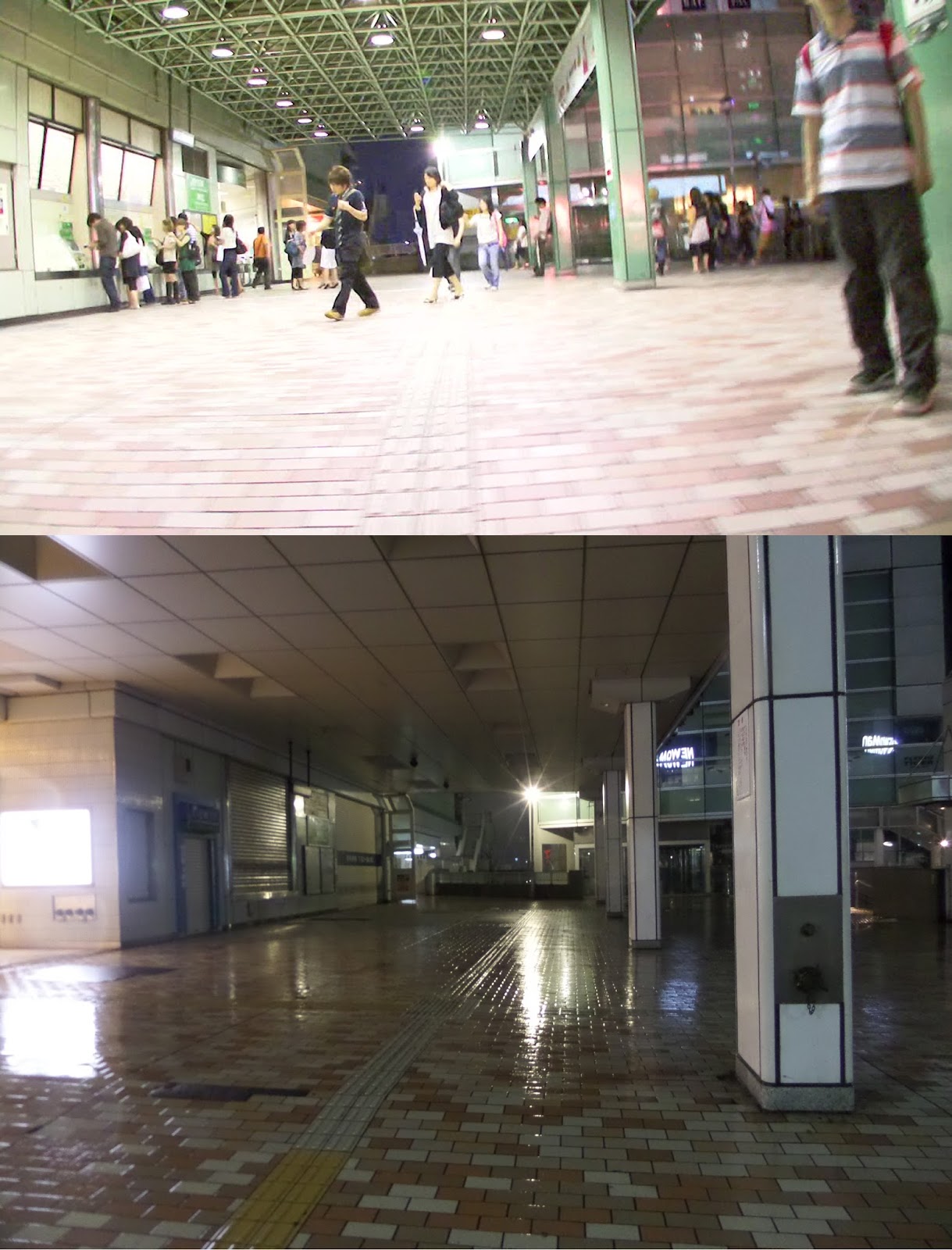
And so, when I found myself awake at two o'clock one morning, I took the chance to go to Shinjuku and photograph places I'd seen in Rumi Nagashima's film. To put things in some kind of context, it was late at night and she was trying to get the last train back after an evening out, and she needed to find the disabled access to Shinjuku Station.


So, for example, she heads towards the elevator to the station. As you can see, the artistic flooring (above) has been replaced by something more functional (below).


In the film, she was too late to actually use the elevator. If only she'd waited ten years, she would've found the elevator still open and operational.


Bits of Shinjuku.


More bits.


Sadly, the new album by Koda Kumi is not longer being advertised here.


Mostly the differences are minor, like a new logo on a shop front...


But this one bothered me. You see, I always thought that traffic cones were a temporary measure. Something used for a fixed period until a more permanent solution comes along. But in this photo, we can see that traffic cones have been used in the same area for about ten years. And what, exactly, are they doing?


Crossing a bridge. Kind of similar.


And once she's at the station, nothing much at all had changed.

As a piece of history, it seems quite faithful to reality. She talks to her mum about the TV news over breakfast, she works as a Girl Guide leader in the afternoon and goes out in the evening. While I expect they chose a day when she'd be doing something active, it doesn't seem particularly staged. In the nicest possible way: it's certainly dull enough to be real life.

Worth a look.

No subs, though.

Friday, 29 May 2015

Seas, shrines and cemeteries

So, in a desperate attempt at getting at least one post written this month, I thought I’d do a brief post about my trip to Japan.

Last time I was in Japan, I had an odd reaction near the end of my stay there. I was walking around a temple and I felt acutely aware of the gulf between me and Japan. I really didn’t understand what I was looking at. At best I could appreciate as a beautiful building, but that was all. It all felt quite touristy and unsatisfying.

This time I decided to go to Japan for my own reasons. Not to see famous tourist attractions, but because I wanted to see certain things with my own eyes.

First, I visited Nara because I’d found an old guidebook published in the 1960s. I wanted to go to Nara and compare the old photos with what found. So I did.


Next I wanted to spend some proper time in and around Matsue. I loved it last time, so I booked an eight-night stay. First, I went to the Shimane Art Museum to see for myself evidence of a new superstition based around a sculpture of rabbits running across a field.


Apparently, if you have an offering of Shijimi clam shells (from the shores of the local lake) and rub the head or back of the first or second rabbit and then pray to it, it will bring you good luck.

This sculpture “Shinjiko Usagi” or “Lake Shinji Rabbits” was made by Yabuuchi Satoshi in 1999, so I reckon that the person who started this superstition is still alive. I find that interesting.

Unfortunately, no one could explain to me why the second rabbit was more popular than the first.


Next on my list of things to do was visit Kute, a small village which I only went to because I saw on Google Maps that it had a cemetery on a cliff. I thought, that looks interesting. And it was.


In fact, I ended up visiting quite a few cemetaries during my stay in Japan. Not on purpose, that’s just how it turned out.

Next I visited the Oki Islands. However, I hadn’t properly understood the need to spend the night there to make it worth your while. After the ticket for the ferry to get there and back, this was just a really expensive three-hour walk. Still, I went to Nishinoshima where I found a shrine with lots of aging wishes tied to its grill.


Finally, once I’d left Matsue and arrived back in Osaka I went back to see Kyoto. Just for one day. My main reason was to find a tiny torii which was next to a vending machine (you can actually see it on Google Street View). It had been there on my previous two visits, and this time I was determined to ask around to find out why it was there.

If I understood correctly (which is a big “if”) that street used to be a tow path for barges carrying goods up from Osaka. The purpose of that torii (and this is a bit shakey) is beyond that point you couldn’t go to that toilet. It seemed odd, but they definitely said “toire ga dame desu” twice.

Whatever used to lie beyond there, though, I’ve no idea.


I did lots of other things too, of course, but most of the time the best bits were when I stopped following tourist directions and walked about a bit at random.

A very nice holiday. No idea when I’ll be going back, though.